Summer escape
Transporting sounds that capture endless sunsets, warm air and ocean nights.
Play subtle ocean waves in the background while you explore.

Sunset sets, ocean breeze and uplifting energy. Festival Island is your escape to the ultimate summer state of mind
— created by D-Tune.
Festival Island is more than an album. It is a feeling, a place and a summer memory in the making.
Transporting sounds that capture endless sunsets, warm air and ocean nights.

From euphoric highs to deeper, blissful moments of connection.
Uplifting melodies, driving beats and hypnotic energy for the dancefloor.
Carefully crafted and mixed to deliver a premium festival experience.
Every stage, every corner of the island — mapped out so you never miss a beat.
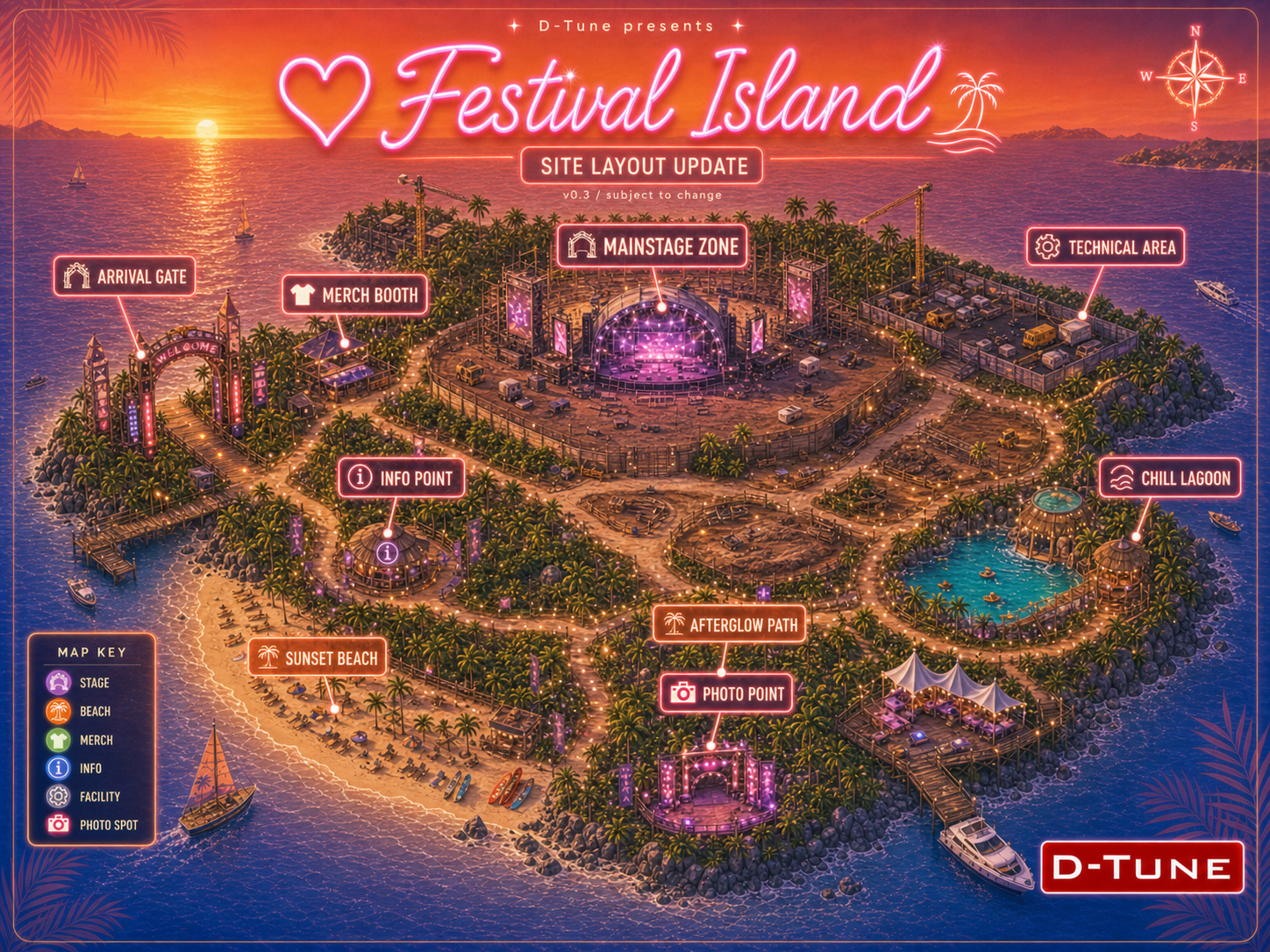
Stories from the build, the music and the road to Festival Island.

The Food Court is a distinct zone on the eastern side of the island, outside the Mainstage bowl but connected to the main pedestrian spine. It is not…
Read moreThe Food Court is a distinct zone on the eastern side of the island, outside the Mainstage bowl but connected to the main pedestrian spine. It is not a row of vendors next to the stage - it is a separate area with its own entry points, seating plan, and flow logic.
Twenty-four vendor positions. Covered seating for approximately 1,200 people. Open seating on the surrounding ground for another 800. The entire zone can be reached without entering the bowl area, which means people can eat, rest, and return without fighting upstream crowd pressure.
The vendor mix covers food, non-alcoholic beverages, and a small number of retail positions. Alcohol is managed separately through dedicated points inside the bowl perimeter.

The original plan had one dock. It made sense on the drawing - one controlled point of entry, everything managed in one place. The event safety consu…
Read moreThe original plan had one dock. It made sense on the drawing - one controlled point of entry, everything managed in one place.
The event safety consultant reviewed it in the third week of May and said: one dock does not work at this capacity. If 300 people are arriving on a boat and a security check is running at the same time, you have a bottleneck. If public departure overlaps with a VIP transfer, an artist arrival, or a production delivery, you have a worse problem. One dock is a single point of failure for the entire transport system.
Festival Island now operates three separate docking points. They do not share traffic.
Main Arrival Dock - public access only, beside the Sunset Beach side of the island. A longer pier with two berths, handling all ticketed guest arrivals and departures. Queue management, security check, wristband activation. No VIP transfers, no artist transfers, no crew logistics.
VIP Dock - separate premium arrival and exit point on the south-eastern side. VIP guests, press, and invited access arrive here, then move directly toward VIP Cove and the dedicated holding area. This keeps smaller passenger vessels away from the public arrival process.
Service + Artist Dock - backstage and logistics only, behind the Mainstage. Artists, technical crew, production deliveries, and service runs use this dock, then follow the service route around the rear of the stage and into the production zone.
Three docks, three functions, zero crossover with the public arrival flow. We did not know we needed even this much separation in May.

The FOH platform position was confirmed at 118 meters on axis. What was not confirmed until we put a person on a 4-meter scaffold at that position was…
Read moreThe FOH platform position was confirmed at 118 meters on axis. What was not confirmed until we put a person on a 4-meter scaffold at that position was that the delay tower at 62 meters partially blocks the lower third of the stage face from the FOH sightline.
Not the screen. Not the top of the structure. The lower stage deck and the downstage performer area - partially obstructed.
The fix: the FOH platform height was increased from 4 to 5.2 meters. This cleared the sightline over the delay tower. The platform structure was redesigned. The foundation load was recalculated. The delivery was rescheduled.
This is why sight line verification happens with a person on a scaffold, not with a drawing.

The first full pedestrian flow map looked good. The path curves were smooth, the zones were well-separated, and the visual logic was clean. The proble…
Read moreThe first full pedestrian flow map looked good. The path curves were smooth, the zones were well-separated, and the visual logic was clean. The problem was that a curved path between the Food Court and the Photo Spot crossed directly in front of an evacuation corridor exit.
In normal operation: fine. In an evacuation: the pedestrian flow and the evacuation flow would converge at the same point, in the same direction, at the same time. That is not an acceptable overlap.
The path was redrawn as a straight diagonal. It is less elegant. The evacuation corridor is now clear. Sometimes a pretty path is a bad path.

At the start of this month, the plan was: build a stage, run power to it, bring people in by boat. The stage was the centre of everything. It was the…
Read moreAt the start of this month, the plan was: build a stage, run power to it, bring people in by boat. The stage was the centre of everything. It was the first thing on the map and the thing everything else was arranged around.
Four weeks of consultations later, the sequence is reversed. The stage is the last thing that arrives. Before the stage can go up, there has to be a road behind it for service vehicles, power drops in the ground below it, drainage around its footprint, a dock that can take heavy equipment without disrupting public arrival, and a crew facility that is separate from everything the audience will see.
We learned this gradually, from people who had done it before. Some of it was obvious in retrospect. None of it was obvious at the start.
The map that exists today does not look like the map from May 5th. That is progress.
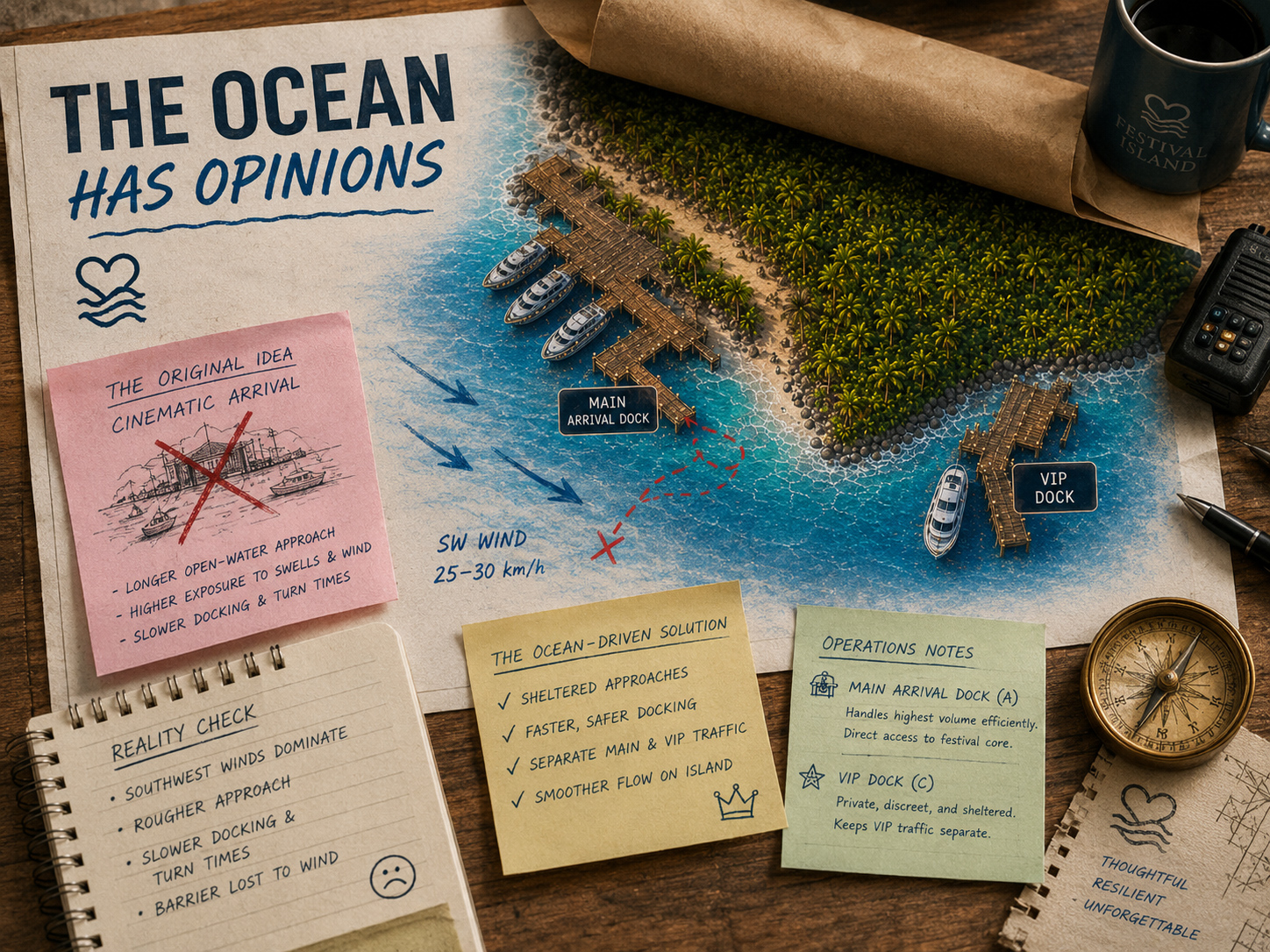
The Main Arrival Dock is the first operational point every ticketed guest passes through. It is not a separate zone on the island - it is the controll…
Read moreThe Main Arrival Dock is the first operational point every ticketed guest passes through. It is not a separate zone on the island - it is the controlled arrival edge shown on the map, where boats unload into the check-in and security process.
The dock handles security check, ticket verification, wristband activation, and basic orientation. The layout uses parallel processing lanes to distribute the incoming flow from boat arrivals. Between each boat arrival, the lanes reset. The goal is a maximum 8-minute wait from stepping off the boat to clearing the dock-side checks.
Beyond the dock, the path releases guests onto the island: one route bends toward Sunset Beach and the western side, while the main pedestrian spine continues toward the Mainstage bowl, Food Court, and Chill Lagoon. The split is deliberate - it distributes the initial crowd before it concentrates.

Sunset Beach is on the south-western edge of the island, beside the public arrival side rather than replacing it. It faces the open water and catches…
Read moreSunset Beach is on the south-western edge of the island, beside the public arrival side rather than replacing it. It faces the open water and catches the afternoon light directly. On a clear evening, the sun sets over the water from this position.
Guests enter through the Main Arrival Dock process first. After that, the beach becomes the first slow zone available from the pedestrian route.
The beach area is for recreation: sitting, watching the water, photography, and the kind of slow time that a festival often does not leave room for. There are no vendor positions on the beach itself. No stages. No amplified sound - the Mainstage audio does not carry cleanly to this side of the island at full distance.
It is a quiet zone in an event that will not be quiet.
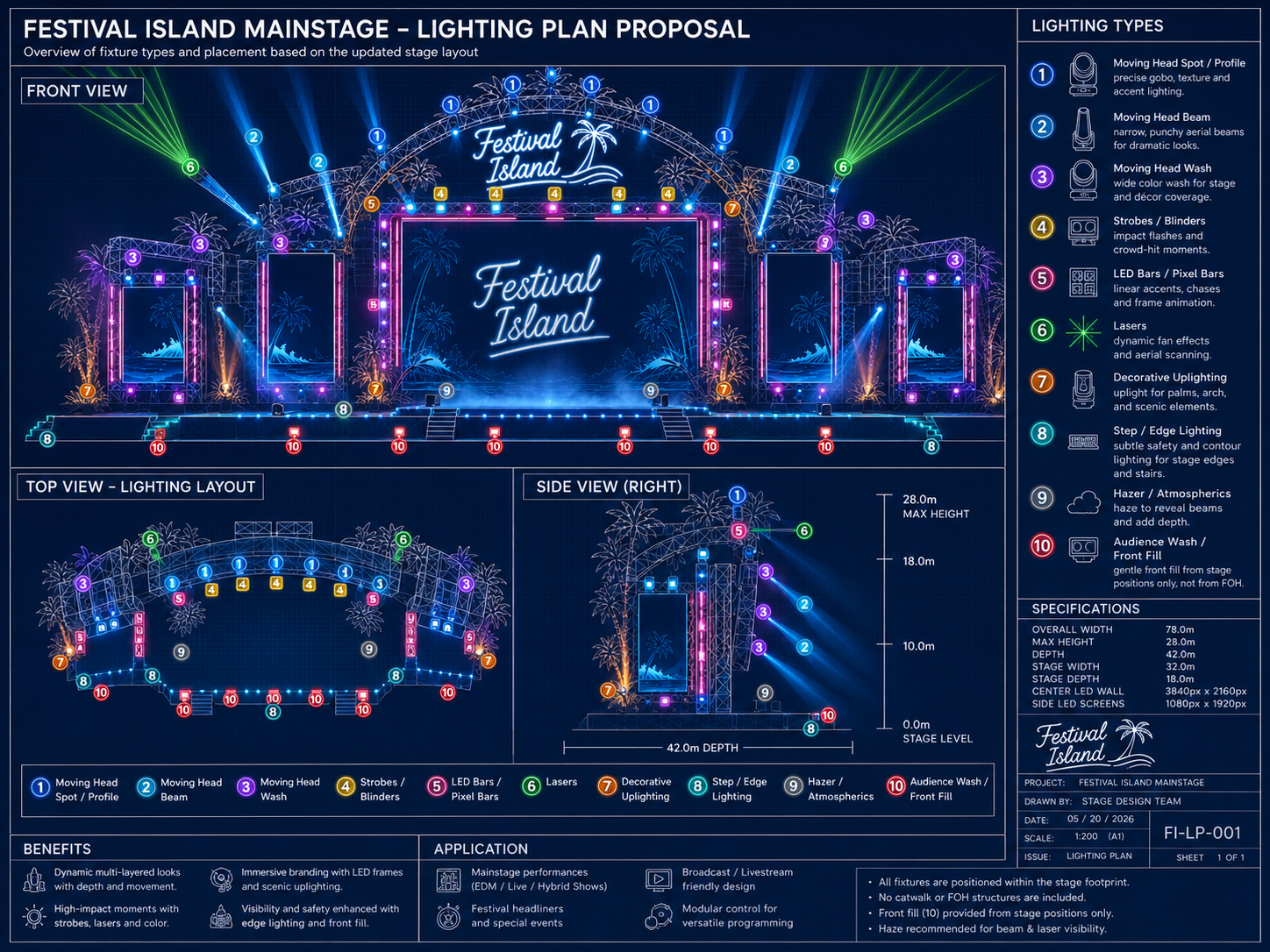
The Stage Lab is not a physical space yet - it is a simulation environment. We test LED configurations, lighting angles, visual palettes, and show con…
Read moreThe Stage Lab is not a physical space yet - it is a simulation environment. We test LED configurations, lighting angles, visual palettes, and show control sequences in a controlled setting before anything goes on the island.
This week's tests focused on the primary colour palette: magenta, cyan, amber, and violet. The combinations were evaluated for readability at FOH distance (118m), lateral bleed at the edges of the bowl, and wash quality during low-ambient-light conditions. Two combinations were eliminated because the magenta and amber interaction created a muddy mid-range at distance.
The LED brightness calibration is set to 60% for outdoor daylight and 35% for post-23:00. Higher than 35% after dark creates audience eye fatigue. Lower than 60% during the golden hour transition loses visibility.
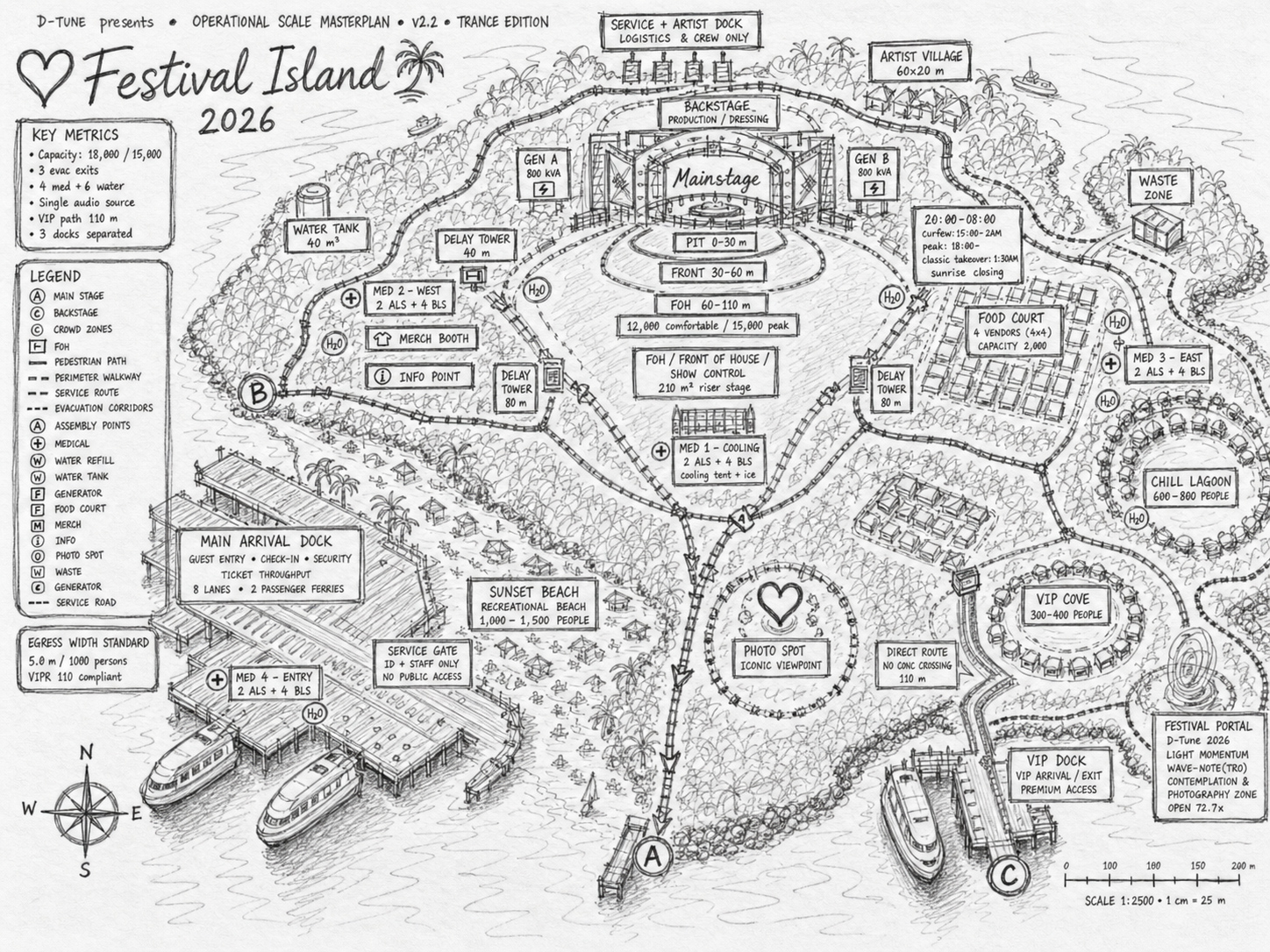
The crowd flow specialist arrived on Monday. She does this for a living - modeling how people move through temporary sites, where they slow down, wher…
Read moreThe crowd flow specialist arrived on Monday. She does this for a living - modeling how people move through temporary sites, where they slow down, where they stop, where they push.
She looked at our map for about ten minutes. Then she started pointing.
The main path from the arrival dock to the Mainstage would work fine at 3,000 people. At 10,000 it becomes a corridor. At 15,000, if two groups are moving in opposite directions at the same time - people leaving the bowl and people coming from food - it stops moving at all.
The beach was an arrival zone in the original version. She said: no. The beach cannot be an arrival zone. You cannot control a beach. People spread out, they sit down, they stop. You need a dock, lanes, and a controlled transition from boat to island. The beach is for later in the night.
We redesigned the pedestrian map from scratch. It took the rest of the week. The new version is less beautiful than the old one. It will work.
Subscribe to the D-Tune channel and be the first to hear new music, behind-the-scenes content and exclusive island drops.
Free. No spam. Just music.